Estate Homes on Spacious Lots in Eastern Mecklenburg — Zoning, Permits & Building Guide
PETERS CUSTOM HOMES
Custom Home Builder Mint Hill NC
Estate Homes on Spacious Lots in Eastern Mecklenburg — Zoning, Permits & Building Guide
QUICK ANSWER
What does it cost to build a custom home in Mint Hill?
A custom home in Mint Hill runs roughly $400-$725+ per heated square foot for construction in 2026, excluding the homesite, difficult-lot site work, pools and landscape. Expect 14-24 months from design through move-in. Peters Custom Homes builds 8-10 residences a year, Mint Hill among them, so pricing is quoted open-book against an itemised budget rather than a single square-foot figure.
UPDATED APRIL 2026
Mint Hill occupies a unique position in the Charlotte metro: a Mecklenburg County community that retains the spacious, semi-rural character most suburbs have long since surrendered. With lot sizes regularly exceeding one acre — and many parcels spanning two to five acres — Mint Hill offers families the kind of estate-scale building canvas that inner Charlotte neighborhoods simply cannot provide.
Peters Custom Homes serves discerning families in Mint Hill who recognize that exceptional custom home construction should not be limited to Myers Park or Eastover. We bring the same architectural rigor, material integrity, and founder-led oversight to every Mint Hill engagement.
What makes Mint Hill particularly compelling for custom building in 2026 is the intersection of available land, favorable zoning, and Mecklenburg County infrastructure — a combination that allows for true estate construction with public utilities, CMS school access, and proximity to I-485.
Estate Homes in Mint Hill
**Zoning & Land Use in Mint Hill:** Mint Hill operates under the Town of Mint Hill's own zoning ordinance, separate from Charlotte's Unified Development Ordinance. Key zoning districts for residential construction include R-1 (minimum 40,000 SF lots), R-2 (minimum 20,000 SF), and R-3 (minimum 15,000 SF). The R-1 district — which covers much of eastern Mint Hill — provides the generous lot sizes ideal for estate-scale construction. Conditional zoning applications in Mint Hill are reviewed by the Town Planning Board and approved by the Town Council. The process is typically more straightforward and faster than Charlotte-Mecklenburg's process, with decisions often rendered within 60–90 days.
**Lot Types & Infrastructure:** Mint Hill homesites fall into two categories: (1) Lots with Charlotte-Mecklenburg Utility Department (CMUD) public water and sewer — available in most established subdivisions, and (2) Lots requiring private well and septic systems — common on larger acreage parcels in eastern and southern Mint Hill. For well/septic properties, our pre-construction process includes comprehensive soil percolation testing (required by Mecklenburg County Environmental Health), well feasibility studies, and engineered septic system design. Budget $50K–$150K+ for well and advanced septic systems depending on soil conditions and lot size.
**Homesite Evaluation Checklist:** • Confirm zoning district (R-1, R-2, or R-3) and allowable density • Verify water/sewer availability or well/septic feasibility • Check flood zone classification (FEMA Zone AE along Goose Creek and tributaries) • Survey existing tree canopy — Mint Hill enforces tree preservation requirements • Assess topography for foundation costs (Piedmont clay soils are common) • Review any HOA architectural standards if in a planned community
Architectural Collaboration
Building in Mint Hill requires a builder who understands both the Town's specific regulatory environment and the construction challenges unique to eastern Mecklenburg. Peters Custom Homes coordinates architects, civil engineers, and geotechnical consultants to navigate the permitting process efficiently.
Our collaborative design-build approach integrates construction expertise into architectural planning from day one — ensuring that site-specific factors like well placement, septic field location, and tree preservation requirements inform the architectural design rather than constraining it after the fact.
Building Private Estates
**Permitting & Inspections:** Mint Hill building permits are issued by the Town of Mint Hill's Planning & Zoning Department, with inspections conducted by Mecklenburg County Code Enforcement. This dual-jurisdiction process requires coordination between town and county agencies — a process Peters Custom Homes manages seamlessly. • Building permit applications typically require 2–4 weeks for review • Site plan approval is required for all new construction • Tree removal permits are required for trees exceeding 8" DBH on lots under 5 acres • Stormwater management plans are required for significant impervious surface additions
Every Peters Custom Homes project in Mint Hill follows our proven construction process: comprehensive homesite analysis, collaborative design development, detailed pre-construction planning, and disciplined construction under daily senior leadership oversight. Quality standards remain identical regardless of location.
Construction timelines in Mint Hill typically align with our standard 14–24 month build schedule, with potential extensions for well and septic installations that must be completed before foundation work begins.
Living in Mint Hill
Mint Hill provides exceptional value for families seeking estate-quality living within Mecklenburg County. The community's position along I-485 ensures convenient connectivity to Uptown Charlotte (25 minutes), SouthPark (20 minutes), and Matthews/Indian Trail (10 minutes) while maintaining the quiet, tree-lined character that distinguishes Mint Hill from Charlotte's denser suburbs.
The area is served by Charlotte-Mecklenburg Schools, with highly rated options including Mint Hill Middle School and Rocky River High School. Several private school options are also within easy reach, including Charlotte Latin, Providence Day, and Covenant Day.
For families comparing Mint Hill to Union County communities like Weddington or Marvin, the key differentiator is municipal infrastructure: Mint Hill offers the combination of large lots with Mecklenburg County services, public utilities on many properties, and the CMS school system — advantages that Union County's more rural parcels often lack.
Frequently Asked Questions
What zoning districts in Mint Hill allow estate-scale custom homes?
Mint Hill's R-1 zoning district requires minimum 40,000 SF (≈1 acre) lots — ideal for estate construction. R-2 (20,000 SF min) and R-3 (15,000 SF min) districts also support custom homes. Mint Hill operates under its own zoning ordinance, separate from Charlotte's UDO, with faster rezoning decisions typically rendered within 60–90 days.
Do Mint Hill properties require well and septic systems?
It depends on location. Established subdivisions typically connect to Charlotte-Mecklenburg Utility Department (CMUD) public water and sewer. Larger acreage parcels in eastern and southern Mint Hill often require private well and septic systems. Budget $50K–$150K+ for well and advanced septic depending on soil conditions.
How does the Mint Hill permitting process work?
Building permits are issued by the Town of Mint Hill Planning & Zoning Department, with inspections conducted by Mecklenburg County Code Enforcement. Plan review takes 2–4 weeks. Tree removal permits are required for trees exceeding 8" DBH on lots under 5 acres. Peters Custom Homes manages the full dual-jurisdiction process.
What do lots cost in Mint Hill compared to inner Charlotte?
Mint Hill lots range from $100K for improved subdivision lots to $400K+ for larger acreage parcels. By comparison, similar-sized lots in Myers Park command $800K–$2M+ and Eastover exceeds $1M. Mint Hill delivers 40–60% land cost savings while remaining in Mecklenburg County with CMS school access.
What schools serve Mint Hill families?
Mint Hill is served by Charlotte-Mecklenburg Schools, including Mint Hill Middle School and Rocky River High School. Private school access includes Charlotte Latin, Providence Day, and Covenant Day — all within 20–30 minutes via I-485.
How do I begin the process of building with Peters Custom Homes?
Every engagement begins with a private consultation where we learn about your family's vision, timeline, and goals. From there, we guide you through homesite evaluation, architect selection, design development, and the full scope of pre-construction planning. We accept a limited number of new engagements each year, so we encourage interested families to reach out early to discuss availability.
What sets a Peters Custom Home apart after move-in?
The difference reveals itself in the details you experience daily—doors that close with a whisper, natural light that shifts beautifully through carefully placed windows, materials that age gracefully, and mechanical systems that perform silently and efficiently. Our families consistently tell us that the quality of daily life in their home exceeds even their highest expectations, and that the residence continues to surprise and delight years after completion.
Private Wellness Environments of Architectural Distinction
Estate Home Pools and Outdoor Living
Extending the Residence into the Landscape
Designing Outdoor Kitchens for
Professional Entertaining in the Open Air
PRIVATE INQUIRY
Inquire about building in Mint Hill
Share a few details and Nicholas Peters will follow up personally within one business day.
WHY FAMILIES CHOOSE PETERS CUSTOM HOMES
The discreet standard for architecturally significant residences in Mint Hill.
8–10
ESTATE ENGAGEMENTS PER YEAR
Founder-led capacity is intentionally limited so Nicholas Peters remains personally involved from first sketch through final walkthrough.
BBB RATED · TOP 1% NC CONTRACTOR
Google 4.9★ (79) · Houzz 5.0★ (14) and BuildZoom recognition — the measurable record behind a decade of estate work.
$2M–$15M+
INVESTMENT RANGE WE SERVE
Private estates designed and constructed for families who measure value in generations, not square feet.
CONFIDENTIAL CONSULTATIONS · NO OBLIGATION
CONCIERGE: (980) 414-4194
Begin Your Estate Vision
Peters Custom Homes accepts a limited number of engagements annually in the Mint Hill area. Contact us to discuss your vision for a custom estate in this exceptional community.
Explore More
FEATURED RESOURCES — COMMON QUESTIONS
What clients usually ask
EXPLORE NEIGHBORHOODS
Charlotte Builder Full-service custom home building in Charlotte VISIT
Waxhaw Country estate living south of Charlotte VISIT
Eastover Estate homes in Charlotte's historic enclave VISIT
Foxcroft Equestrian estates and wooded homesites VISIT
SERVICES & CAPABILITIES
Design Collaborative architectural design for estate homes VISIT
The Peters Method Our five-step journey from concept through completion VISIT
Renovations Luxury whole-home and kitchen renovations VISIT
FEATURED RESOURCES
The Journal Editorial articles on luxury building VISIT
Resources Hub Every guide, page, and resource VISIT
Cost Calculator Estimate your luxury build cost VISIT
About Nicholas Peters Founder story and authority VISIT
PRIVATE CONSULTATION
If this page reflects what you're considering, we welcome a confidential conversation about your vision.
Mint Hill is an area-level entry for a town on Charlotte's eastern edge, known in the source for larger lots, a rural-leaning character, golf courses and growing new construction near the I-485 corridor. It lists the town center and the Stevens Mill corridor as sub-areas, so it is not one uniform setting.
Larger homesites often invite questions that smaller suburban lots do not: well or septic, long driveways, grading, outbuildings and tree preservation. Newer construction near the corridor brings association and compact-setback issues. The source mentions golf, but it does not say which properties adjoin courses. Because the character is described as rural-leaning, drainage and soils deserve early attention. A good brief places the property in the town center, corridor, golf-adjacent or larger-lot category, then investigates utilities and site constraints accordingly. Because this is an area-level heading, treat everything above as a starting map and not a description of any one property; the useful facts will come from the parcel, its documents and a site visit.
Is the property on public sewer, or on septic with capacity limits?
What drainage and soil conditions affect foundations and outbuildings?
Does the parcel adjoin a golf course or sit under association review?
The Mint Hill Planning Context
Mint Hill sits on Charlotte’s eastern edge and is known for larger homesites, a rural-leaning character, golf settings and new development near I-485. Its historical society village and town center provide a distinct civic anchor, while the Stevens Mill corridor reflects ongoing growth. The broad setting includes varied parcel sizes and development patterns; town limits and available services should be confirmed for each property.
A larger lot can make an addition, detached workspace or new house seem simple, but boundaries, easements, tree cover, drainage and utility reach determine the practical building area. Check zoning, setbacks, access and any association or golf-community design process before settling on a footprint. Existing homes may offer scope for modernization, yet additions can compromise mature-tree canopy or rural character if placement is not carefully studied. New-build feasibility should include soils, grading, stormwater and service connections, especially on less-developed sites. Near I-485 or growth corridors, assess traffic noise and construction access at the actual parcel. Renovation can limit site disturbance and retain landscape, while replacement may improve layout and efficiency; compare both after structural and systems inspections.
Making the Homesite Work Before Designing Rooms
For new construction in an established residential setting, first determine the buildable envelope and how the building can be accessed. A current boundary and topographic survey can reveal easements, slope and conflicts that are not evident from an aerial image. Evaluate tree protection, utility connections and drainage with the responsible professionals. A neighboring house is evidence of a different approved project, not automatic permission for the same footprint on this lot.
Compare at least two massing approaches: a wider ground-level arrangement and a more compact plan with additional upper-floor space. The alternatives affect yard continuity, roof geometry, stair use, accessibility and construction access. Place garages and outdoor rooms so they support daily circulation rather than consuming every remaining edge of the site. Confirm recorded covenants and association requirements separately from public zoning before investing in detailed elevations.
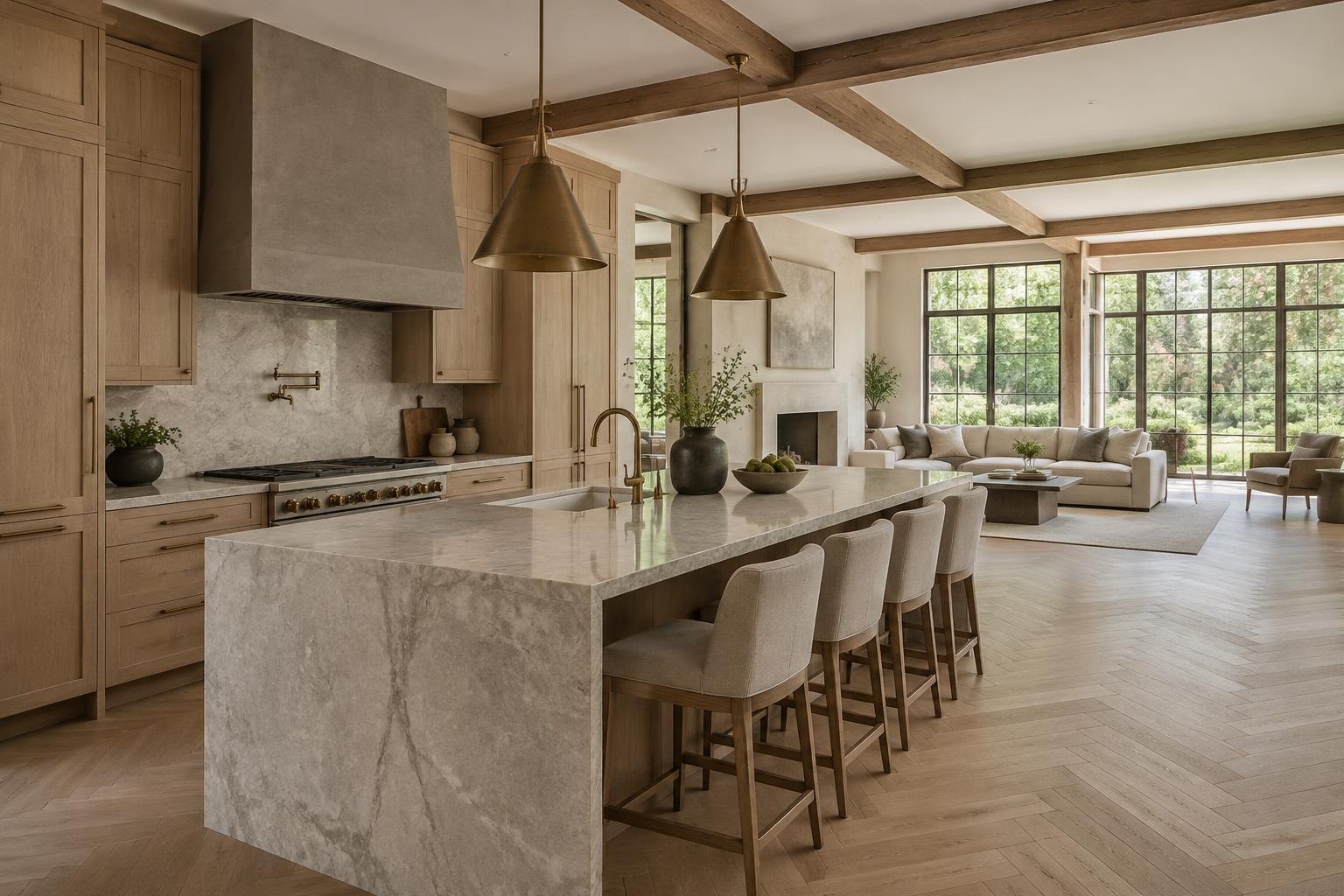
AI-generated architectural concept — not a photograph of this community, a completed Peters project, or an available property.
Renovation, Addition or New Construction
The decision to retain a home starts with its structure and site relationship. Investigate foundation condition, roof framing, existing alterations, moisture history and the capacity of electrical and mechanical systems. Removing a wall or extending a room can require more coordination than a finish-only project. Obtain a measured plan and define which elements must remain before asking for a construction estimate.
Compare a carefully planned renovation with an addition that addresses the same functional goals. Reorganizing circulation can sometimes improve a kitchen or primary suite without enlarging the entire building; an addition may provide a better result when the existing geometry cannot accommodate the program. Replacement construction is a separate option only where feasible and approved. Make that choice using comparable scopes, verified constraints and long-term usability rather than an assumption about neighborhood value.
Approvals, Evidence and the Construction Sequence
For Mint Hill, use the address and parcel identifier to establish which office handles zoning, building review and any environmental or shoreline work. The linked Mecklenburg resources are starting points, not a determination that every property named in the area falls within that office's authority. Municipal exceptions and boundary differences matter. Ask for a written list of the approvals relevant to the proposed scope, then distinguish those requirements from any architectural-review or association process.
A practical sequence is to assemble the survey, ownership and restriction documents, existing drawings and condition investigations; compare concept alternatives; define the retained and new work; coordinate engineering and systems; and prepare the appropriate submittals. Permits and private approvals should be resolved before relying on a start date. Long-lead selections, temporary access and inspection stages belong in the construction plan rather than being left to informal assumptions.
For renovation, record which spaces can remain occupied, how dust and weather protection will work, and how unexpected concealed conditions will be handled. For new construction, establish utility and site-work responsibilities and identify decisions that must be made before foundations or underground systems proceed. Ask estimates to distinguish building work, design services, site conditions and optional outdoor improvements so alternative proposals can be compared honestly.
Is the property in town limits, and which zoning, access, and service rules apply?
What survey, easements, tree and drainage conditions constrain the buildable area?
Are golf or neighborhood covenants and review procedures applicable?
How do current structure condition and I-485 exposure affect renovation or rebuild choices?
Preparing a Useful Mint Hill Project Brief
Bring the property address, survey if available, photographs of existing conditions and a prioritized room or improvement list. Separate essential needs from optional additions. For an existing residence, note known leaks, previous structural changes and any drawings or permits already held. For land, identify known access and utility arrangements without assuming that a listing description proves buildability. A clear brief helps the team identify the right investigation before detailed design.
Peters Custom Homes evaluates custom residences and substantial renovations individually. Inclusion of Mint Hill in this guide does not imply a completed local project, a local office, a property for sale or a commitment to accept every scope. Concept images are architectural illustrations rather than site proposals. The useful next step is an address-specific conversation about goals, constraints and whether the project fits the firm's work. Obtain current agency guidance and professional advice before making a purchase or construction decision.
Sources & Property Verification
Community names were inventoried from Charlotte Luxe Living on October 18, 2026. Design ideas are planning considerations, not verified parcel conditions. Public permits, recorded restrictions and association decisions must be checked independently. No local project history, available property, school assignment or approval is implied.