Custom Waterfront and Golf-Side Estates for Cornelius's Most Established Lake Norman Community
PETERS CUSTOM HOMES
The Peninsula, Lake Norman — Custom Home Builder
Custom Waterfront and Golf-Side Estates for Cornelius's Most Established Lake Norman Community
QUICK ANSWER
What does it cost to build a custom home in Cornelius?
A custom home in Cornelius runs roughly $400-$725+ per heated square foot for construction in 2026, excluding the homesite, difficult-lot site work, pools and landscape. Expect 14-24 months from design through move-in. Peters Custom Homes builds 8-10 residences a year, Cornelius among them, so pricing is quoted open-book against an itemised budget rather than a single square-foot figure.
UPDATED APRIL 2026
The Peninsula is the most established luxury waterfront community on Lake Norman — a 1,300-acre peninsula in Cornelius wrapped on three sides by the lake, anchored by The Peninsula Club's Rees Jones golf course and the Peninsula Yacht Club. Families who choose to build here are not buying a lot; they are stepping into a community that has been refining what lakefront living looks like in the Carolinas for more than three decades.
Peters Custom Homes builds a small number of private residences in The Peninsula each year, working with families on waterfront, golf-side, and interior estate lots. This page outlines what you should expect when planning a custom build inside the community — from architectural review and dock permitting to lot orientation and the specific cost considerations that distinguish a Peninsula build from a build elsewhere on the lake.
Estate-tier homes in The Peninsula typically run from $2M to $10M+ depending on lot value, waterfront frontage, and program scope. Discreet, ARC-aligned design and patient pre-construction planning are what separate a residence that integrates into the community from one that fights against it.
Estate Living in Cornelius
The Peninsula's Architectural Review Committee maintains design guidelines that favor enduring, regionally-appropriate architecture — transitional, shingle-style, coastal, and refined traditional vocabularies tend to receive smoother review than aggressive contemporary forms. Submission packets require schematic, design-development, and construction-document review with the ARC at defined milestones; expect 8-14 weeks of cumulative ARC time across the design phases.
Material palettes are reviewed alongside elevations. Standing-seam metal accents, cedar shake, lap and shingle siding, brick and stone bases, and quiet roof colors generally pass review without rework. We pre-meet with the ARC during schematic design to surface any concerns before drawings are committed — this single step has saved our families months of revision cycles on past Peninsula builds.
Lot setbacks, height limits, and tree-save requirements are enforced strictly. The ARC also reviews exterior lighting, driveway materials, mailbox style, landscape master plans, and dock plans. We treat the ARC as a design partner rather than an obstacle, which has produced approvals on every Peters submission to date.
Architectural Collaboration
Waterfront lots in The Peninsula require coordination with Duke Energy's Lake Services group for any shoreline modification — docks, lifts, seawalls, retaining walls, dredging, and rip-rap placement all fall under Duke's Shoreline Management Program. Permits typically run 90-180 days and must align with the Lake Norman Lake Use Plan and the community's own dock standards.
Dock design itself is a discipline. Pier length, slip count, lift type (cradle versus floating), roof pitch, and decking material all factor into both the Duke permit and the ARC review. We work with Lake Norman dock specialists who have built successful Peninsula dock packages for more than a decade and who carry the right insurance and licensure to operate on Duke-managed shoreline.
Seawall condition is the single most important pre-purchase due-diligence item on any Peninsula waterfront lot. We inspect existing seawalls during land acquisition; replacement or major repair can add $80K-$250K to a project budget and 3-6 months to the construction schedule. Our land acquisition evaluation walks families through the full waterfront feasibility checklist before a contract is signed.
Building Private Estates
Lot orientation is the second decision that defines the home. The Peninsula's geography means most waterfront lots face east or west across the main channel; sun angles, wind exposure, and neighbor sightlines all shift dramatically across the community. We site every Peninsula home to optimize evening light on the primary outdoor living spaces while protecting the primary suite from morning glare.
Topography matters too. Several Peninsula sub-neighborhoods sit on meaningful grade, which affects basement feasibility, walk-out potential, drive geometry, and stormwater design. Walk-out lower levels with full daylight and lake views are achievable on the right lot; on others, a slab-on-grade or partial basement is the better engineering decision. We model the site in 3D before schematic design begins.
Programs we have built in The Peninsula range from primary residences with lake-side primary suites and shoreline outdoor living, to multi-generational compounds with carriage houses for visiting family, to refined empty-nester residences with smaller footprints and elevated finish levels. Style fit varies by sub-neighborhood — older sections favor traditional and shingle vocabularies, newer sections accept more transitional and coastal-modern forms.
Living in Cornelius
Living in The Peninsula is defined by water access, walkable golf, and the rhythm of the Yacht Club and the Peninsula Club calendars. Families considering a build here are typically choosing between The Peninsula and a handful of Lake Norman waterfront alternatives — The Point, The Sanctuary, and Skybrook North — each with different ARC cultures, club programs, and resale dynamics.
We help families think through that comparison during the discovery conversation, drawing on completed work and current builds elsewhere on Lake Norman. The right answer depends on lifestyle priorities, lot inventory at the moment of search, and whether club membership at The Peninsula Club or Peninsula Yacht Club is part of the long-term plan.
Recent and active Peters work in and around The Peninsula is available for private, by-appointment tours. We do not publish addresses for client privacy, but we are happy to walk a serious prospective family through a current build at framing or trim-out so the standard of work is visible firsthand.
Frequently Asked Questions
What is required to build in The Peninsula on Lake Norman?
Covenant-governed architectural review, community construction rules, and — on waterfront parcels — coordination with lake shoreline requirements affecting bulkheads, docks, and buffers.
How does a waterfront lot change the design?
The lake elevation becomes the primary front. Living space, primary suite, and covered outdoor living orient to the water, with garage and service functions placed streetside, and glazing detailed for both view and solar exposure.
What extra costs come with a Lake Norman waterfront build?
Slope stabilization and grading, drainage and stormwater management, shoreline and dock coordination, and an exterior envelope detailed to a standard that reads well from the water as well as the street.
Is dock permitting part of the project?
Dock and shoreline work is permitted separately through the lake authority process. We coordinate it alongside construction so the shoreline program and the residence resolve as one project.
How do I begin the process of building with Peters Custom Homes?
Every engagement begins with a private consultation where we learn about your family's vision, timeline, and goals. From there, we guide you through homesite evaluation, architect selection, design development, and the full scope of pre-construction planning. We accept a limited number of new engagements each year, so we encourage interested families to reach out early to discuss availability.
What sets a Peters Custom Home apart after move-in?
The difference reveals itself in the details you experience daily—doors that close with a whisper, natural light that shifts beautifully through carefully placed windows, materials that age gracefully, and mechanical systems that perform silently and efficiently. Our families consistently tell us that the quality of daily life in their home exceeds even their highest expectations, and that the residence continues to surprise and delight years after completion.
CONTINUE EXPLORING
EXPLORE MORE
Related Guides
Barclay Downs Custom Home Builder in Charlotte
Quail Hollow Adjacency, Country Club Living, and SouthPark Convenience
Olde Providence Custom Home Builder in South Charlotte
Established Lots, Mature Canopy, and Top-Tier Public Schools
Sherwood Forest Custom Home Builder in Charlotte
Estate Lots, Generous Footprints, and Quiet Privacy
Ballantyne Country Club Custom Home Builder
Golf Course Estates, Gated Privacy, and Refined Country Club Living
Concord and Cabarrus County Custom Home Builder
Acreage Estates, Spillover Luxury, and Northeast Charlotte Privacy
Tear Down and Rebuild in Charlotte, NC
Replacing an Underperforming Home in Myers Park, Eastover, Foxcroft and Cotswold With a Peters-Built Estate
Energy Efficient Custom Homes in Charlotte, NC
High-Performance Building Envelopes, Geothermal Options, and Optional Net-Zero Specifications for Carolina Estates
Smart Home Builder in Charlotte, NC
Lutron, Crestron, Savant, Whole-Home Audio Video and Circadian Lighting Designed In From Day One
PRIVATE INQUIRY
Inquire about building in Cornelius
Share a few details and Nicholas Peters will follow up personally within one business day.
WHY FAMILIES CHOOSE PETERS CUSTOM HOMES
The discreet standard for architecturally significant residences in Cornelius.
8–10
ESTATE ENGAGEMENTS PER YEAR
Founder-led capacity is intentionally limited so Nicholas Peters remains personally involved from first sketch through final walkthrough.
BBB RATED · TOP 1% NC CONTRACTOR
Google 4.9★ (79) · Houzz 5.0★ (14) and BuildZoom recognition — the measurable record behind a decade of estate work.
$2M–$15M+
INVESTMENT RANGE WE SERVE
Private estates designed and constructed for families who measure value in generations, not square feet.
CONFIDENTIAL CONSULTATIONS · NO OBLIGATION
CONCIERGE: (980) 414-4194
Begin Your Estate Vision
If a custom residence in The Peninsula is on your three-year horizon, the right next step is a discovery conversation — not a contract. We will discuss your program, the lot inventory we are aware of, ARC and dock realities, and whether a Peters engagement is the right fit for your project.
Reach out to npeters@peterscustomhomes.com to schedule a Peninsula consultation. We respond within one business day to every inquiry and treat every conversation as confidential.
Explore More
WATERFRONT & LAKE — COMMON QUESTIONS
What clients usually ask
EXPLORE NEIGHBORHOODS
Charlotte Builder Full-service custom home building in Charlotte VISIT
Waxhaw Country estate living south of Charlotte VISIT
Eastover Estate homes in Charlotte's historic enclave VISIT
Foxcroft Equestrian estates and wooded homesites VISIT
SERVICES & CAPABILITIES
Design Collaborative architectural design for estate homes VISIT
The Peters Method Our five-step journey from concept through completion VISIT
Renovations Luxury whole-home and kitchen renovations VISIT
WATERFRONT & LAKE
Lake Norman Luxury Homes Waterfront estates on Lake Norman VISIT
Lake Wylie Builder Lake Wylie waterfront builder VISIT
Cost to Build Waterfront What waterfront luxury actually costs VISIT
Lake Norman Building Guide Permitting and construction on Lake Norman VISIT
PRIVATE CONSULTATION
If this page reflects what you're considering, we welcome a confidential conversation about your vision.
The Peninsula is listed as a community within the Cornelius grouping, but this inventory entry supplies no narrower source location or explanatory note. A construction or renovation investigation should begin with the actual property rather than inferred amenities, access rights or architectural controls. Confirm the address, recorded subdivision and survey, then gather existing construction records. Any facilities or entitlements important to the owner’s decision need independent documentation. The community name alone does not establish the physical conditions, permissions or services associated with a particular parcel.
For an existing residence, compare the measured arrangement with the household’s desired balance of shared rooms, private accommodation and everyday storage. Investigate structural spans and service routes before proposing larger openings or moving wet rooms. If an addition is contemplated, assess its impact on daylight, usable exterior space, roof drainage and construction access. Verify applicable public requirements and any recorded private review procedures before committing to exterior massing. A condition assessment and outline cost plan could distinguish essential renewal from discretionary changes, helping the owner decide whether a targeted renovation or a more comprehensive transformation is justified by the actual building rather than assumptions attached to its location.
Which documents establish the property’s exact identity and any relevant entitlements?
Can structural spans and service routes accommodate the preferred room changes?
How would the proposed addition affect daylight, drainage and construction access?
The Cornelius Planning Context
Cornelius is a Lake Norman town where residential life is strongly oriented to shoreline, marinas and lakeside destinations. Jetton Park and Ramsey Creek Park provide public recreation, while The Peninsula and the Jetton Road waterfront are recognizable residential settings. The town also contains inland neighborhoods and newer places such as Antiquity, so “lake town” does not mean every parcel has shoreline or the same relationship to the water.
For a waterfront renovation, distinguish deeded frontage, shared access and distant lake proximity before shaping the brief. Existing docks, seawalls and shoreline structures merit independent permitting and condition checks; past installation is not proof of current authorization. Sloped or narrow lots can make construction staging and foundation work consequential, and preserving a view corridor may compete with privacy, shade and tree retention. Inland projects face a different balance: additions, garages and outdoor rooms can be planned around neighborhood circulation and shared design expectations. Older custom homes may have opportunities for internal modernization, but large-scale room changes should follow structural and building-system assessments. A new build should test grading, drainage, utility connections and access for equipment before finalizing the house footprint. Confirm whether community facilities or architectural review affect exterior work.
Making the Homesite Work Before Designing Rooms
For new construction in an established residential setting, first determine the buildable envelope and how the building can be accessed. A current boundary and topographic survey can reveal easements, slope and conflicts that are not evident from an aerial image. Evaluate tree protection, utility connections and drainage with the responsible professionals. A neighboring house is evidence of a different approved project, not automatic permission for the same footprint on this lot.
Compare at least two massing approaches: a wider ground-level arrangement and a more compact plan with additional upper-floor space. The alternatives affect yard continuity, roof geometry, stair use, accessibility and construction access. Place garages and outdoor rooms so they support daily circulation rather than consuming every remaining edge of the site. Confirm recorded covenants and association requirements separately from public zoning before investing in detailed elevations.
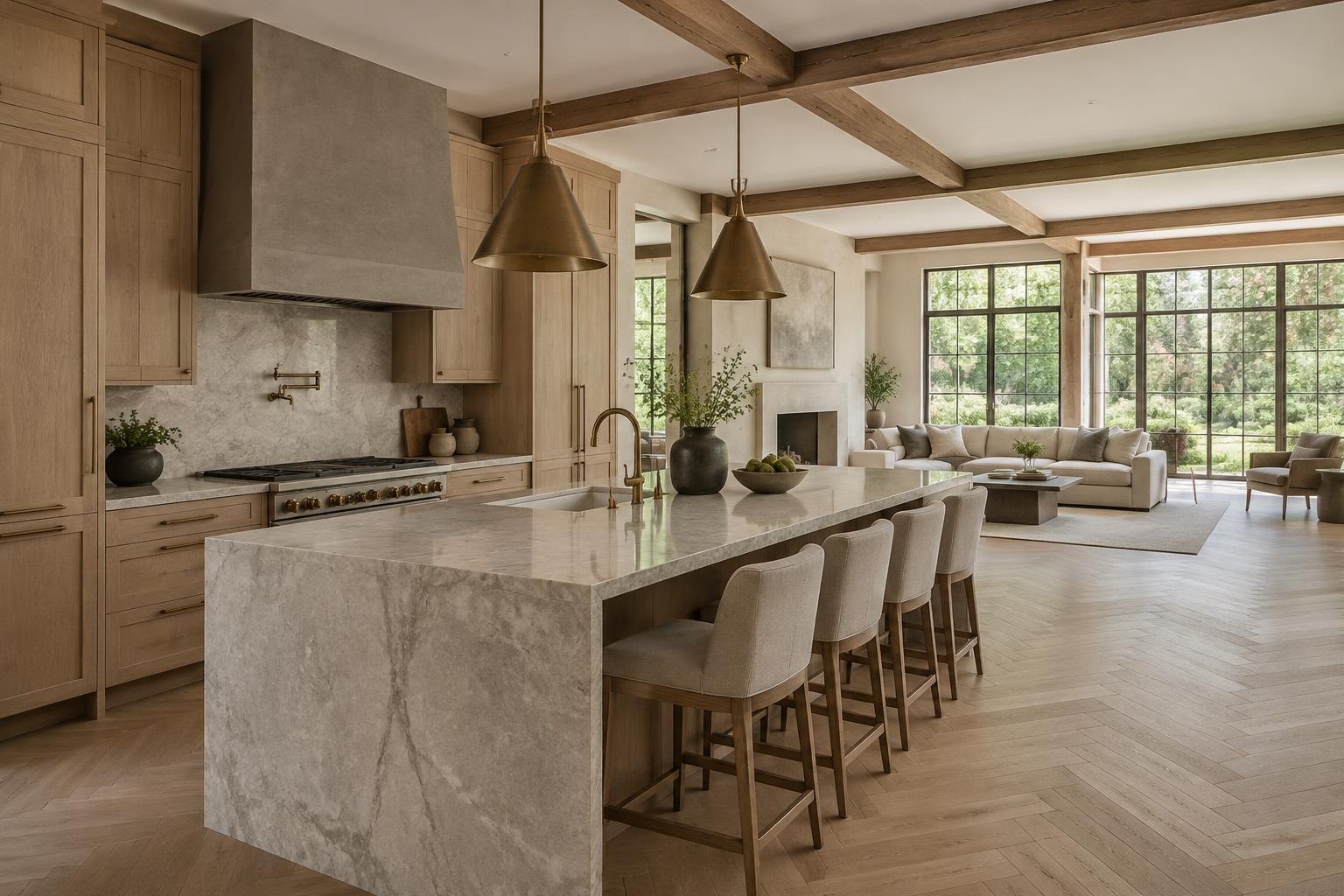
AI-generated architectural concept — not a photograph of this community, a completed Peters project, or an available property.
Renovation, Addition or New Construction
The decision to retain a home starts with its structure and site relationship. Investigate foundation condition, roof framing, existing alterations, moisture history and the capacity of electrical and mechanical systems. Removing a wall or extending a room can require more coordination than a finish-only project. Obtain a measured plan and define which elements must remain before asking for a construction estimate.
Compare a carefully planned renovation with an addition that addresses the same functional goals. Reorganizing circulation can sometimes improve a kitchen or primary suite without enlarging the entire building; an addition may provide a better result when the existing geometry cannot accommodate the program. Replacement construction is a separate option only where feasible and approved. Make that choice using comparable scopes, verified constraints and long-term usability rather than an assumption about neighborhood value.
Approvals, Evidence and the Construction Sequence
For The Peninsula, use the address and parcel identifier to establish which office handles zoning, building review and any environmental or shoreline work. The linked Mecklenburg resources are starting points, not a determination that every property named in the area falls within that office's authority. Municipal exceptions and boundary differences matter. Ask for a written list of the approvals relevant to the proposed scope, then distinguish those requirements from any architectural-review or association process.
A practical sequence is to assemble the survey, ownership and restriction documents, existing drawings and condition investigations; compare concept alternatives; define the retained and new work; coordinate engineering and systems; and prepare the appropriate submittals. Permits and private approvals should be resolved before relying on a start date. Long-lead selections, temporary access and inspection stages belong in the construction plan rather than being left to informal assumptions.
For renovation, record which spaces can remain occupied, how dust and weather protection will work, and how unexpected concealed conditions will be handled. For new construction, establish utility and site-work responsibilities and identify decisions that must be made before foundations or underground systems proceed. Ask estimates to distinguish building work, design services, site conditions and optional outdoor improvements so alternative proposals can be compared honestly.
What exactly conveys with the parcel: frontage, access rights, dock, and shoreline structures?
Which permits and inspections support existing shoreline improvements?
What are the lot’s slope, erosion, drainage, and construction-access constraints?
Do recorded covenants or review procedures govern additions, exterior materials, or site work?
Preparing a Useful The Peninsula Project Brief
Bring the property address, survey if available, photographs of existing conditions and a prioritized room or improvement list. Separate essential needs from optional additions. For an existing residence, note known leaks, previous structural changes and any drawings or permits already held. For land, identify known access and utility arrangements without assuming that a listing description proves buildability. A clear brief helps the team identify the right investigation before detailed design.
Peters Custom Homes evaluates custom residences and substantial renovations individually. Inclusion of The Peninsula in this guide does not imply a completed local project, a local office, a property for sale or a commitment to accept every scope. Concept images are architectural illustrations rather than site proposals. The useful next step is an address-specific conversation about goals, constraints and whether the project fits the firm's work. Obtain current agency guidance and professional advice before making a purchase or construction decision.
Sources & Property Verification
Community names were inventoried from Charlotte Luxe Living on October 18, 2026. Design ideas are planning considerations, not verified parcel conditions. Public permits, recorded restrictions and association decisions must be checked independently. No local project history, available property, school assignment or approval is implied.